
| SobekCM Repository Community Help |
Other Titles Element Help
Definition
Other Titles refers to title information after the title proper; including Series Titles, Translated Titles, Alternative Titles, and Uniform titles.
The title is a word, phrase, character, or group of characters, normally appearing in a resource, that names it or the work contained in it. 1
The entire title field consists of the title and may also contain the general material designation (medium), remainder of title, other title information, the remainder of the title page transcription, and statement(s) of responsibility. The title proper includes the short title and alternative title, the numerical designation of a part/section and the name of a part/section. For mixed material, the title statement is defined as the name by which the material is known. 2
In addition, the following subelements exist for any additional title to associate with material:
| Subelement | Definition |
|---|---|
| Subtitle | a word, phrase, character, or group of characters that contains the remainder of the title information after the title proper.2 |
| Part Number | identifies the place a single item holds in a collection or series of works, for example, a volume or series number |
| Part Name | identifies the title of an individual item in a collection or series of works and should not be confused with the Subtitle field |
| Non Sort terms | includes any title-initial articles that should not be used during database searches, for example, if the title proper begins with “the”, “a”, or “an”, this initial article would be entered into the Non Sort field, and the rest of the title would be entered in the main title field. |
| Language | indicates the language of this included title |
| Authority | may be used to indicate that a title is controlled by a record in an authority file |
| Display Label | often used to capture relevant scope information about the title, which otherwise would not be accomodated |
Finally, a title type is included for titles which are not the main title. The table below explains the differences between each title type:
| Title Type | Definition |
|---|---|
| Alternative Title | A variation of the main title |
| Abbreviated Title | A shorter version of the main title |
| Series Title | The title of a series to which the item belongs |
| Translated Title | The original or translated title of a foreign language item |
| Uniform Title | The title chosen to represent a work that has appeared under varying titles |
Form Element
In the online templates, this element appears as below:

Upon clicking or typing in the main box, the form below appears to give access to all the individual components of the other titles element:
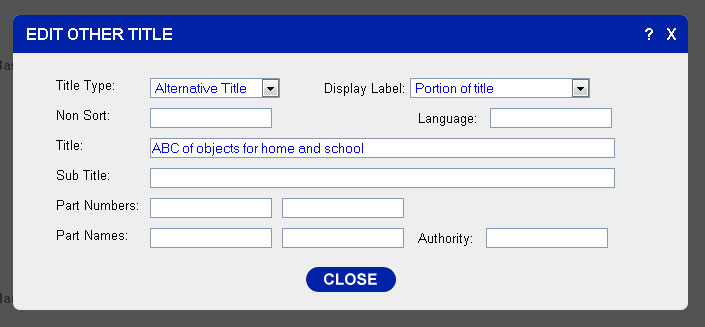
This form element allows the user to enter just the simple title text for an alternative title, abbreviated title, series title, uniform title, or translated title. The non-sort element of the title (leading article or punctuation) should be included.
Other form elements for entering title information include Main Title and Complex Title Entry. A title used as a subject should be entered through one of the subject form elements.
Best Practices
Not all items will require Other Titles, but the Other Title field is repeatable.
Title: All items should include information in the Title field, and Non Sort terms should be entered in the Non Sort field. Title information may come from the cover or title page of a book or document or may come from a description of a map or image. The origin of title information may be noted in the Note field, for example, “Title information from cover page”.
Example: The Americans in Panama
Subtitle: Not all items will have a subtitle. Information that appears in a title after a colon, or appears after the title on the title page but not on the cover or half title page, should be included as a subtitle.
Example: The Aftermath of the Trujillo dictatorship: the emergence of a pluralist political system...
Part Number: Not all items will have a Part Number. The part number should be included on the title page of an item.
Example: Saint Nicholas: Volume 9, no. 12. October 1882.
Part Name: Not all items will have a Part Name. The part name should be included on the title page of an item.
Example: pending
Statement of Responsibility: Some items will not have a statement of responsibility. If phrases such as “by” or “edited by” or “by the author of” appear on the item, this information should be included in the Statement of Responsibility.
Example: Jack and Florie, or, The Pigeons' wedding
Language: Languages should be entered either by the ISO code, or by the term from the MARC Code List of Languages.
Example: pending
Authorities: The name of the authoritative list for a controlled value is recorded here. An authority attribute may be used to indicate that a title is controlled by a record in an authority file (e.g. authority="naf"). A list of authority files is maintained at: www.loc.gov/marc/sourcecode/authorityfile/authorityfilesource.html. Title authorities can also be accessed at http://authorities.loc.gov/cgi-bin/Pwebrecon.cgi?DB=local&PAGE=First .
Example: pending
Title Type:Select the title type most appropriate. Below are some additional considerations by other title type:
| Title Type | Additional Considerations |
|---|---|
| Alternative Title | If a title proper contains numerals or symbols, an alternative title should be added with the numbers or symbols written out. It a title proper contains an alternative title, the title information following the "or" should be entered as an alternative title. |
| Series Title | If an item contains series information, a series title should be included. |
| Translated Title | If a translation exists from the main title to any other language (including English if the original item's title is not in English) the translated title should appear here. |
SobekCM / MODS Encoding
This data is encoded entirely in the MODS section of the SobekCM METS file.
<mods:titleInfo authority="authority" lang="language" type="type" displayLabel="display">
<mods:nonSort>Nonsort portion </mods:nonSort>
<mods:title>Main portion</mods:title>
<mods:subTitle>Subtitle portion</mods:subTitle>
<mods:partNumber>Part number(s)</mods:partNumber>
<mods:partName>Part name(s)</mods:partName>
</mods:titleInfo>
<mods:titleInfo type="translated" lang="fr">
<mods:nonSort>L'</mods:nonSort>
<mods:title>homme qui voulut être roi</mods:title>
</mods:titleInfo>
<mods:titleInfo type="alternative" displayLabel="also known as">
<mods:nonSort>The</mods:nonSort>
<mods:title>Man Who Be King</mods:title>
</mods:titleInfo>
<mods:titleInfo type="uniform" authority="naf">
<mods:title>Great works of England</mods:title>
<mods:partNumber>2nd</mods:partNumber>
<mods:partName>Second Portion</mods:partName>
</mods:titleInfo>
<mods:relatedItem type="series">
<mods:titleInfo>
<mods:title>Pleasewell series</mods:title>
</mods:titleInfo>
</mods:relatedItem>
Metadata Mapping
MARC to MODS Mapping
The non-main titles map from the 130, 210, 240, 242, 246, 440, 490, 730, and 740 fields. All of these mappings obey the following guidelines:
- After using a indicator field (if preset) to determine the nonsort portion, the remainder of the |a subfield is mapped into the title portion.
- The |b subfield is mapped into subtitle
- The |i subfield is mapped into the display label
- The |n subfield is mapped into the part numbers
- The |p subfield is mapped into the part names
- The |y subfield is mapped into the language part
In addition, the following distinctions are made during the mapping process depending on the field number:
- MARC 130 field
- type is set to uniform
- the first indicator tells the length of the nonsort portion
- display label is set to Main Entry
- MARC 210 field
- type is set to abbreviated
- the first indicator tells the length of the nonsort portion
- MARC 240 field
- type is set to uniform
- the second indicator tells the length of the nonsort portion
- MARC 242 field
- type is set to translated
- the second indicator tells the length of the nonsort portion
- MARC 246 field
- type is set to alternative
- the second indicator determines the display label:
- 0 → Portion of title
- 1 → Parallel title
- 2 → Distinctive title
- 3 → Other title
- 4 → Cover title
- 5 → Added title page title
- 6 → Caption title
- 7 → Running title
- 8 → Spine title
- otherwise, Alternate Title
- MARC 440 field
- this maps into a series title
- the second indicator tells the length of the nonsort portion
- MARC 490 field
- this maps into a series title
- MARC 730 field
- type is set to uniform
- the first indicator tells the length of the nonsort portion
- display label is set to Uncontrolled
- MARC 740 field
- type is set to alternative
- the first indicator tells the length of the nonsort portion
- display label is set to Uncontrolled
MODS to MARC Mapping
Mapping from the MODS back to MARC is the reverse of the procedure listed above. The length of the non-sort portion of the title determines the indicator and each portion of the title maps into the appropriate subfield. Specifically, the following mappnig is used:
- Abbreviated titles map to 210, with no indicator set for non-sort
- Alternative titles map depending on their display label
- Uncontrolled → 740, with the first indicator set for non-sort
- otherwise, 246, with the first indicator set to '3' and the second indicator set by display label (reverse of mapping listed above)
- Series titles map into the 490 field, with no indicator set for non-sort
- Translated titles map to 242, with the second indicator set for non-sort
- Uniform titles map depending on their display label
- Main Entry → 130, with the first indicator set for non-sort
- Uncontrolled → 730, with the first indicator set for non-sort
- otherwise, 240, with the second indicator set for non-sort
In the actual MODS metadata, the series title is implemented a little bit differently, being mapped into a title field under a related item field with type equaling series.
Sources
- MODS User Guidelines Version 3, Detailed Description of MODS Elements
- MARC 21 Format for Bibliographic Data
- MODS to MARC 21 version 3.3 : title
- MARC Mapping to MODS version 3.4 : titleInfo
Contributors
Nicola Hill, Mark Sullivan, and Laurie Taylor