
| SobekCM Repository Community Help |
Complete Subject Element Help
Definition
Subject terms or phrases representing the primary topic(s) on which a work is focused.1
Subject added entries are assigned to a bibliographic record to provide access according to generally accepted thesaurus-building rules (e.g., Library of Congress Subject Headings (LCSH), Medical Subject Headings (MeSH)).2
The topic of the content of the resource. Subject will be expressed as keywords, key phrases or classification codes that describe a topic of the resource. Recommended best practice is to select a value from a controlled vocabulary or formal classification scheme.
Subjects are complex elements and include the following subelements:
- Topical subject terms which consist of general subject terms, including names of events or objects2
- Chronological subject terms
- Geographic subject terms which consist of jurisdiction names and subject subdivisions2
- Form/Genre subject terms indicating the genre, form, and/or physical characteristics of the materials being described. A genre term designates the style or technique of the intellectual content of textual materials or, for graphic materials, aspects such as vantage point, intended purpose, characteristics of the creator, publication status, or method of representation. A form term designates historically and functionally specific kinds of materials distinguished by their physical character, the subject of their intellectual content, or the order of information within them. Physical characteristic terms designate historically and functionally specific kinds of materials as distinguished by an examination of their physical character, subject of their intellectual content, or the order of information with them. 2
- Occupational subject terms
- Name of the Authority the term comes from. A list of authority sources is maintained here.
- The Language of the term may also be included
Form Element
In the online templates, this element appears as below:
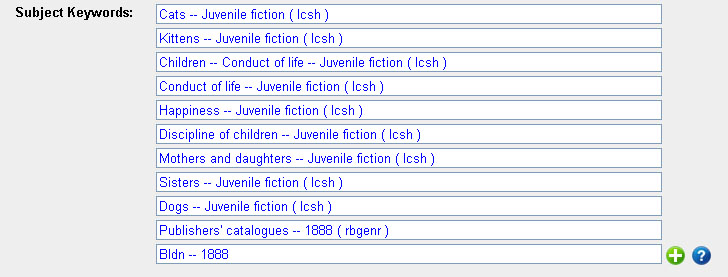
Upon clicking or typing in the main box, the form below appears to give access to all the individual components of the hierarchical spatial subject:
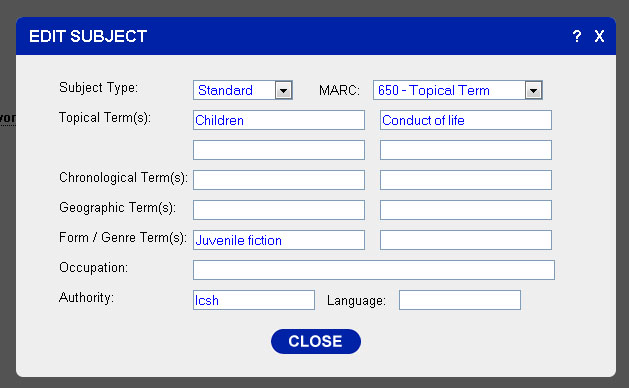
The form allows the user to edit all the possible subelements ( topical, chronological, geographic, form/genre, occupational, authority, and language ). A particular MARC mapping can be forced by selecting the appropriate MARC field to map the subject to.
Besides these standard subject keyword type subjects, subjects can also be created from Titles or Names. (i.e., Title as subject, or Name as subject) Mapping and encoding for these are provided below, although these cannot yet be added through the online metadata template.
Hierarchical geographic terms are also included in the subject element in the MODS schema, but these are entered through the Simplified Spatial and Hierarchical Spatial elements. Their mapping and encoding is included under those form elements.
Other form elements for entering these subject information includes Simplified Subject Metadata Entry.
Best Practices
The best practice for entering ...
Examples
The following are examples of well formatted :...
SobekCM / MODS Encoding
This data is encoded entirely in the MODS section of the SobekCM METS file.
<mods:subject authority="fast">
<mods:topic>Pets and travel</mods:topic>
</mods:subject>
<mods:subject ID="SUBJ651_1" authority="lcsh">
<mods:geographic>Atlantic Coast (Guinea)</mods:geographic>
<mods:genre>Maps</mods:genre>
</mods:subject>
<mods:subject ID="SUBJ651_2" authority="lcsh">
<mods:geographic>Atlantic Coast (Sierra Leone)</mods:geographic>
<mods:genre>Maps</mods:genre>
</mods:subject>
<mods:subject ID="SUBJ691_3" authority="local">
<mods:topic>Maps</mods:topic>
<mods:geographic>Atlantic Coast (Guinea)</mods:geographic>
<mods:temporal>1732</mods:temporal>
</mods:subject>
<mods:subject ID="SUBJ691_4" authority="local">
<mods:topic>Maps</mods:topic>
<mods:geographic>Atlantic Coast (Sierra Leone)</mods:geographic>
<mods:temporal>1732</mods:temporal>
</mods:subject>
<mods:subject authority="lcsh">
<mods:name>
<mods:namePart>Garcia Lorca, Federico</mods:namePart>
<mods:namePart type="date">1898-1936</mods:namePart>
</mods:name>
</mods:subject>
<mods:subject authority="naf">
<mods:titleInfo type="uniform">
<mods:title>Missale Carnotense</mods:title>
</mods:titleInfo>
</mods:subject>
Metadata Mapping
MARC to MODS Mapping
The subject keyword terms can be found in various MARC fields in the 6xx fields. Many of these are set up very similarly and allow access to many of the subelements through the MARC subfields. However, which subfield maps into which subelements varies by the MARC field. The table below shows this mapping:
| MARC Field | → Topical | → Geographic | → Temporal | → Genre | → Occupation | → Source |
|---|---|---|---|---|---|---|
| 648 | |x | |z | |a, |y | |v | |2, indicators | |
| 650 | |a, |x | |z | |y | |v | |2, indicators | |
| 651 | |x | |a, |z | |y | |v | |2, indicators | |
| 653 | |a | |2 | ||||
| 654 | |a, |v | |y | |z | |2, indicators | ||
| 655 | |x | |z | |y | |a, |v | |2, indicators | |
| 656 | <|x/td> | |z | |y | |v | |a | |2, indicators |
| 657 | |a, |x | |z | |y | |v | |2, indicators | |
| 690 | |a, |x | |z | |y | |v | |2, indicators | |
| 691 | |x | |a, |z | |y | |v | |2, indicators |
The second character in the indicator (in all cases except 653) indicate the authority as well:
- 0 → lcsh
- 1 → lcshac
- 2 → mesh
- 3 → nal
- 5 → csh
- 6 → rvm
- 9 → local
Finally, the originating MARC tag is placed in the ID for the XML node holding the subject. This is done to simplify the mapping back into MARC.
The name as subject maps from the 600, 610, and 611.
The title as subject maps from the 630.
MODS to MARC Mapping
Mapping from the MODS back to MARC is the reverse of the procedure listed above.
The process for determining the MARC tag to map into is:
- If there is an occupation field, this maps into 656
- If a MARC tag is found in the ID of the XML node, that is used
- If the only terms are temporal, this is mapped into a 648
- If the only terms are genres, this is mapped into a 655
- If the only terms are geographics, this is mapped into a 651
- Otherwise, the 650 tag is used.
Once the field is determined, mapping is the reverse of the procedure above. For example, with a 650 field, the first topical term maps into the |a subfield and the remaining topical terms map into |x subfields. Geographic terms map into the |z subfields, temporal terms to the |y subfield, and genre/form to the |v subfield.